
What the conversation with Will Fraser tells us about the future of utility-scale solar, biodiversity and long-term project success.
As the UK accelerates its transition towards renewable energy, utility-scale solar developments are becoming increasingly sophisticated. Today’s projects are expected to deliver far more than clean electricity—they must also enhance biodiversity, support agriculture, improve landscape resilience and provide long-term environmental value.
In a recent episode of The Future of Solar Photovoltaics podcast, Will Fraser, Head of Habitat Regeneration at Heathcote Holdings, shared his experience of delivering ecological solutions on some of the UK’s largest solar developments, including Cleve Hill.
Here are ten key lessons from the discussion.
- Biodiversity should be considered from the very beginning
One of the strongest messages throughout the podcast is that successful biodiversity outcomes begin long before construction starts.
Ecology should not be viewed as a planning condition to satisfy once designs have been completed. Instead, habitat specialists should work alongside developers, designers and EPCs from the earliest stages to ensure ecological measures are practical, achievable and cost-effective throughout the life of the project.
Early collaboration reduces future conflicts between infrastructure, cable routes, planting and long-term maintenance.
- A Landscape & Ecological Management Plan is more than a planning document
Landscape and Ecological Management Plans (LEMPs) provide the blueprint for how biodiversity will be delivered over the operational life of a solar farm.
A good LEMP doesn’t simply identify habitats to be created. It sets out:
- habitat objectives
- management prescriptions
- monitoring requirements
- maintenance responsibilities
- measurable ecological outcomes
Most importantly, it ensures habitats remain successful for the next 25–30 years, not just during construction.
- Solar farms can become valuable ecological assets
Modern solar developments provide an opportunity to restore habitats at a landscape scale.
At Cleve Hill, habitat creation included wetland restoration, scrapes, swales, species-rich grassland and improvements to a degraded Site of Special Scientific Interest (SSSI).
Rather than viewing biodiversity as mitigation, projects like these demonstrate how renewable energy can actively improve landscapes while supporting protected species and strengthening ecological networks.
- Renewable energy and agriculture can work together
The debate around food production versus renewable energy continues, but the reality is often more balanced.
Many utility-scale solar farms continue to support agricultural use through sheep grazing beneath the panels, allowing land to produce both clean energy and food while delivering biodiversity enhancements.
This integrated approach demonstrates that renewable energy, farming and environmental stewardship can coexist on the same site.
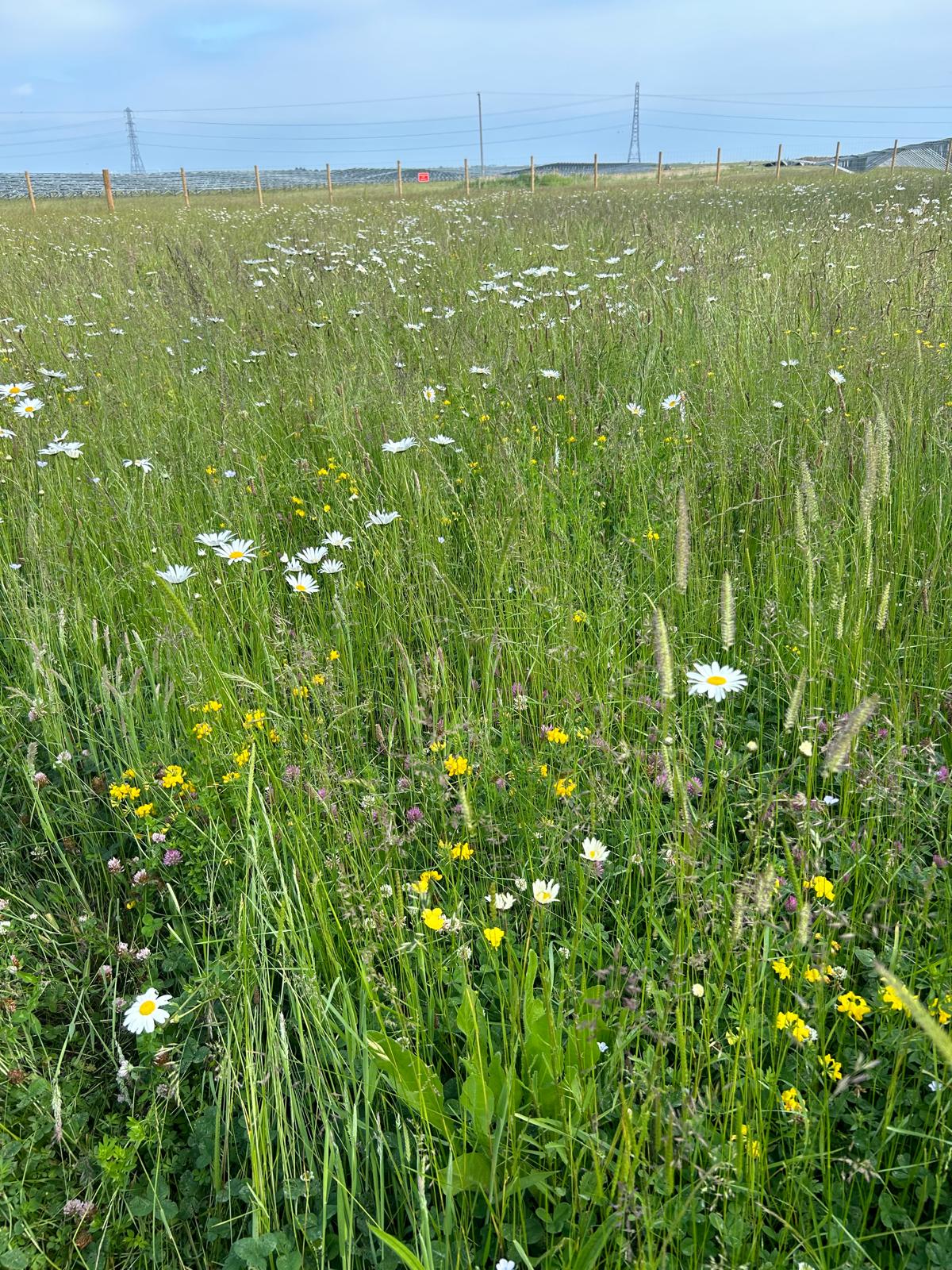
- Wildflower meadows require long-term management
Creating species-rich grassland involves far more than sowing a wildflower seed mix.
Many solar sites have historically been intensively farmed, leaving soils with nutrient levels that favour competitive grasses rather than native wildflowers.
Successful establishment relies on careful soil management, reducing fertility over time through cut-and-collect regimes, selecting appropriate seed mixes and adapting management as habitats develop.
The best meadows are managed, not simply planted.
- Biodiversity Net Gain is only the starting point
The introduction of Biodiversity Net Gain has transformed development across the UK.
Using the Defra Biodiversity Metric, developers can measure habitat improvements against a site’s baseline ecological value.
While legislation currently requires a minimum 10% Biodiversity Net Gain, many solar developments have the opportunity to deliver substantially greater improvements through thoughtful habitat design and long-term management.
- Technology is changing ecological monitoring
New technologies are transforming the way biodiversity is measured.
Drone surveys, AI-powered species recognition and digital habitat mapping allow project teams to monitor ecological performance more accurately than ever before.
By comparing habitat development year after year, land managers can identify where management is succeeding and where changes may be required, ensuring environmental commitments continue to be met throughout the life of the project.
- Habitat creation doesn’t end when construction finishes
One of the biggest misconceptions surrounding biodiversity is that planting marks the end of the process.
In reality, the first two to three years are often the most important.
Tree establishment, meadow management, replacing failed planting, maintaining hedgerows and monitoring habitat performance all contribute to long-term success.
Solar projects should therefore be viewed as long-term environmental assets requiring ongoing stewardship rather than one-off ecological installations.
- Solar projects can deliver wider environmental benefits
The discussion extends beyond biodiversity to consider broader environmental resilience.
Well-designed solar developments can contribute to:
- improved water quality
- nutrient neutrality
- natural flood management
- wetland restoration
- landscape resilience
By carefully managing drainage, creating wetlands and reducing agricultural inputs, solar developments can provide benefits that extend well beyond the site boundary.
- The future of solar is about delivering multiple outcomes
Perhaps the biggest takeaway from the podcast is that the most successful solar farms deliver far more than renewable electricity.
They combine:
- clean energy generation
- biodiversity enhancement
- continued agricultural use
- long-term environmental management
- measurable ecological improvement
- greater resilience for landscapes and communities
As utility-scale solar continues to grow across the UK, projects will increasingly be judged not only by the megawatts they generate but by the lasting environmental legacy they create.
Looking Ahead
The future of utility-scale solar depends on more than engineering excellence. It requires collaboration between developers, EPCs, ecologists, land managers and specialist contractors to deliver projects that balance energy security with environmental responsibility.
At Heathcote Renewables, we believe successful solar developments are those that integrate renewable energy, biodiversity and long-term land stewardship from the outset.
As Will Fraser explains throughout the podcast, when ecology is embedded into project delivery rather than added afterwards, solar developments have the potential to become lasting assets for both people and nature.
Listen to Will Fraser’s full interview on The Future of Solar Photovoltaics podcast to hear more about the opportunities and challenges shaping the next generation of utility-scale solar projects. https://lnkd.in/ewQ_pjd5
